'Backrooms' and the Rise of the Institutional Gothic
141 points - today at 1:18 PM
SourceComments
https://www.youtube.com/watch?v=F74LLDhAhhI
It also very much ties in with the shared SCP universe, which itself has a number of Backrooms-like anomalies, such as SCP-3008 (https://scp-wiki.wikidot.com/scp-3008), which is like a typical IKEA, except its maze of twisty passages run to infinity.
I’ve worked in a place like this that was well past its prime and though uncanny, it’s certainly not creepy.
The illusion of infinitely twisting, identical corridors simply doesn’t hold up when you’re actually in a space like this, but only works if you’ve only ever seen these kinds of spaces from a still photograph on the internet (which is why the audience for this sort of thing is too young to have ever experienced it themselves).
Yes, it looks exactly like the stifling, sprawling suburban office complex I once worked in, but then I also remember the feeling of walking out the exit into a beautiful spring day.
For me, the feeling these “back rooms” evokes is more akin to being in school waiting for the bell to ring so you can go outside and play.
It’s strange when your own mundane experiences are fodder for a new generation’s horror fiction. Sort of takes the bite away from it.
Like when I go into my basement at night, I can give myself the scare of "what if someone's watching ..." then go "nah" and I'm fine.
So I like how the movie's plot seems to be similar as well.
On a technical level, his work is brilliant. With no budget, he puts me in a CGI space that I really can't tell is CGI, and invokes all of the feelings that are familiar to anyone who has snuck around where they really shouldn't be.
>suggests a humanity at the brink of becoming digital objects themselves.
>But one can imagine a different version of this scene: a future humanity similarly excavating remains of corporate hallways that have since crumbled, wondering what life could have been like at the turn of the 20th century.
Relevant, and as spoiler-free as I can make it: I cannot give a stronger recommendation to play NieR and NieR:Automata.
I don't have anything interesting to say about how the backrooms phenomenon has evolved in recent years, but I do find it mildly amusing that I have a very different, but equally horror-themed, reaction to seeing "players" poking around in the original backrooms. Because it immediately gives me flashbacks to the feeling that players have found spots where collusion detection has had a nasty issue (because of bad geometry, or floating point precision errors in the physics system or a NaN, or players abusing the physic system to climb to areas they weren't supposed to), and now there's some awful-to-track-down bug to be fixed during a death march crunch time... all of which actually was a somewhat common occurrence during development at the time, of course.
Obviously, that makes me a lousy target audience for this art movement. But it's been vaguely fascinating watching people enchant, essentially, spaces that were experienced, from our side, as an very brittle (but useful!) optimization hack that we were all too aware could be easily broken.
I wrote a computer game where a paper airplane flies room to room… It occurred to me that I was not indirectly surfacing this "endlessly scrolling building" that has recurred so often in what I suppose are nightmares(?).
At the same time, memory being what it is, I worry that the reverse is true—that the game I write inspired the nightmares (and that I now miss-remember when they began, misattribute them to my teenage years).
There is at times a feeling of infinite possibility when I find myself in these places while dreaming. I always enjoy exploring new places and so a place with infinite rooms, hallways, floors is going to keep me busy.
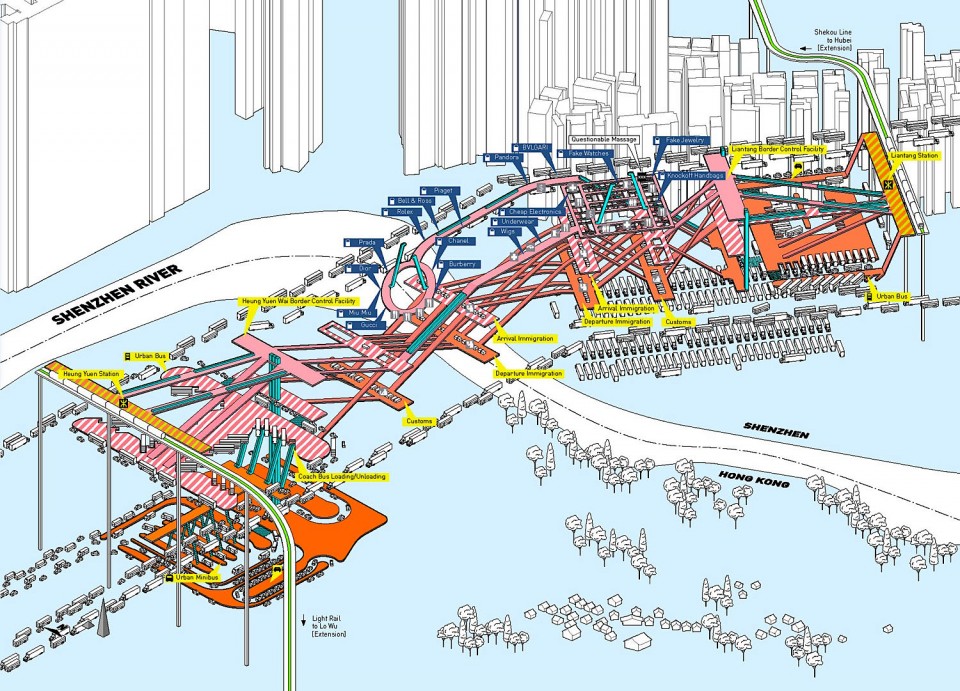
When I learned of Kowloon Walled City [1][2], that caught my attention. I've seen too descriptions of the underground portions of Hong Kong [3] that let you move from place to place without every stepping outside. The movie "Chungking Express" gives off that vibe [4]. The imaginary prisons of Giovanni Battista Piranesi [5].
[1] https://www.visualcapitalist.com/wp-content/uploads/2017/09/...
[2] http://lh5.googleusercontent.com/-xI_c78etYDc/T61_qAwHWFI/AA...

[3] https://weburbanist.com/wp-content/uploads/2014/05/hong-kong...