Google releases Gemma 4 open models
823 points - today at 4:10 PM
SourceComments
We made some quants at https://huggingface.co/collections/unsloth/gemma-4 for folks to run them - they work really well!
Guide for those interested: https://unsloth.ai/docs/models/gemma-4
Also note to use temperature = 1.0, top_p = 0.95, top_k = 64 and the EOS is "<turn|>". "<|channel>thought\n" is also used for the thinking trace!
    | Model          | MMLUP | GPQA  | LCB   | ELO  | TAU2  | MMMLU | HLE-n | HLE-t |
    |----------------|-------|-------|-------|------|-------|-------|-------|-------|
    | G4 31B         | 85.2% | 84.3% | 80.0% | 2150 | 76.9% | 88.4% | 19.5% | 26.5% |
    | G4 26B A4B     | 82.6% | 82.3% | 77.1% | 1718 | 68.2% | 86.3% |  8.7% | 17.2% |
    | G4 E4B         | 69.4% | 58.6% | 52.0% |  940 | 42.2% | 76.6% |   -   |   -   |
    | G4 E2B         | 60.0% | 43.4% | 44.0% |  633 | 24.5% | 67.4% |   -   |   -   |
    | G3 27B no-T    | 67.6% | 42.4% | 29.1% |  110 | 16.2% | 70.7% |   -   |   -   |
    | GPT-5-mini     | 83.7% | 82.8% | 80.5% | 2160 | 69.8% | 86.2% | 19.4% | 35.8% |
    | GPT-OSS-120B   | 80.8% | 80.1% | 82.7% | 2157 |  --   | 78.2% | 14.9% | 19.0% |
    | Q3-235B-A22B   | 84.4% | 81.1% | 75.1% | 2146 | 58.5% | 83.4% | 18.2% |  --   |
    | Q3.5-122B-A10B | 86.7% | 86.6% | 78.9% | 2100 | 79.5% | 86.7% | 25.3% | 47.5% |
    | Q3.5-27B       | 86.1% | 85.5% | 80.7% | 1899 | 79.0% | 85.9% | 24.3% | 48.5% |
    | Q3.5-35B-A3B   | 85.3% | 84.2% | 74.6% | 2028 | 81.2% | 85.2% | 22.4% | 47.4% |

    MMLUP: MMLU-Pro
    GPQA: GPQA Diamond
    LCB: LiveCodeBench v6
    ELO: Codeforces ELO
    TAU2: TAU2-Bench
    MMMLU: MMMLU
    HLE-n: Humanity's Last Exam (no tools / CoT)
    HLE-t: Humanity's Last Exam (with search / tool)
no-T: no thinkhttps://simonwillison.net/2026/Apr/2/gemma-4/
The gemma-4-31b model is completely broken for me - it just spits out "---\n" no matter what prompt I feed it. I got a pelican out of it via the AI Studio API hosted model instead.
> what is the Unix timestamp for this: 2026-04-01T16:00:00Z
Qwen 3.5-27b-dwq
> Thought for 8 minutes 34 seconds. 7074 tokens.
> The Unix timestamp for 2026-04-01T16:00:00Z is:
> 1775059200 (my comment: Wednesday, 1 April 2026 at 16:00:00)
Gemma-4-26b-a4b
> Thought for 33.81 seconds. 694 tokens.
> The Unix timestamp for 2026-04-01T16:00:00Z is:
> 1775060800 (my comment: Wednesday, 1 April 2026 at 16:26:40)
Gemma considered three options to solve this problem. From the thinking trace:
> Option A: Manual calculation (too error-prone).
> Option B: Use a programming language (Python/JavaScript).
> Option C: Knowledge of specific dates.
It then wrote a python script:
  from datetime import datetime, timezone
  date_str = "2026-04-01T16:00:00Z"
  # Replace Z with +00:00 for ISO format parsing or just strip it
  dt = datetime.strptime(date_str, "%Y-%m-%dT%H:%M:%SZ").replace(tzinfo=timezone.utc)
  ts = int(dt.timestamp())
  print(ts)
date -u -d @1775060800
-Chris Lattner (yes, affiliated with Modular :-)
I asked codex to write a summary about both code bases.
"Dev 1" Qwen 3.5
"Dev 2" Gemma 4
Dev 1 is the stronger engineer overall. They showed better architectural judgment, stronger completeness, and better maintainability instincts. The weakness is execution rigor: they built more, but didn’t verify enough, so important parts don’t actually hold up cleanly.
Dev 2 looks more like an early-stage prototyper. The strength is speed to a rough first pass, but the implementation is much less complete, less polished, and less dependable. The main weakness is lack of finish and technical rigor.
If I were choosing between them as developers, I’d take Dev 1 without much hesitation.
Looking at the code myself, i'd agree with codex.
The sizes are E2B and E4B (following gemma3n arch, with focus on mobile) and 26BA4 MoE and 31B dense. The mobile ones have audio in (so I can see some local privacy focused translation apps) and the 31B seems to be strong in agentic stuff. 26BA4 stands somewhere in between, similar VRAM footprint, but much faster inference.
These models are impressive but this is incredibly misleading. You need to load the embeddings in memory along with the rest of the model so it makes no sense o exclude them from the parameter count. This is why it actually takes 5GB of RAM to run the "2B" model with 4-bit quantization according to Unsloth (when I first saw that I knew something was up).
The E2B/E4B models also support voice input, which is rare.
In ChatGPT right now, you can have a audio and video feed for the AI, and then the AI can respond in real-time.
Now I wonder if the E2B or the E4B is capable enough for this and fast enough to be run on an iPhone. Basically replicating that experience, but all the computations (STT, LLM, and TTS) are done locally on the phone.
I just made this [0] last week so I know you can run a real-time voice conversation with an AI on an iPhone, but it'd be a totally different experience if it can also process a live camera feed.
  total duration:       12m41.34930419s
  load duration:        549.504864ms
  prompt eval count:    25 token(s)
  prompt eval duration: 309.002014ms
  prompt eval rate:     80.91 tokens/s
  eval count:           2174 token(s)
  eval duration:        12m36.577002621s
  eval rate:            2.87 tokens/s
Google is the only USA based frontier lab releasing open models. I know they aren't doing it out of the goodness of their hearts.
Gemma 3 was the first model that I have liked enough to use a lot just for daily questions on my 32G gpu.
How does the ecosystem work? Have things converged and standardized enough where it's "easy" (lol, with tooling) to swap out parts such as weights to fit your needs? Do you need to autogen new custom kernels to fix said things? Super cool stuff.
Seems like Google and Anthropic (which I consider leaders) would rather keep their secret sauce to themselves – understandable.
  # with uvx
  uvx litert-lm run \
    --from-huggingface-repo=litert-community/gemma-4-E2B-it-litert-lm \
gemma-4-E2B-it.litertlmOne more thing about Google is that they have everything that others do not:
1. Huge data, audio, video, geospatial 2. Tons of expertise. Attention all you need was born there. 3. Libraries that they wrote. 4. Their own data centers and cloud. 4. Most of all, their own hardware TPUs that no one has.
Therefore once the bubble bursts, the only player standing tall and above all would be Google.
First message:
https://i.postimg.cc/yNZzmGMM/Screenshot-2026-04-03-at-12-44...
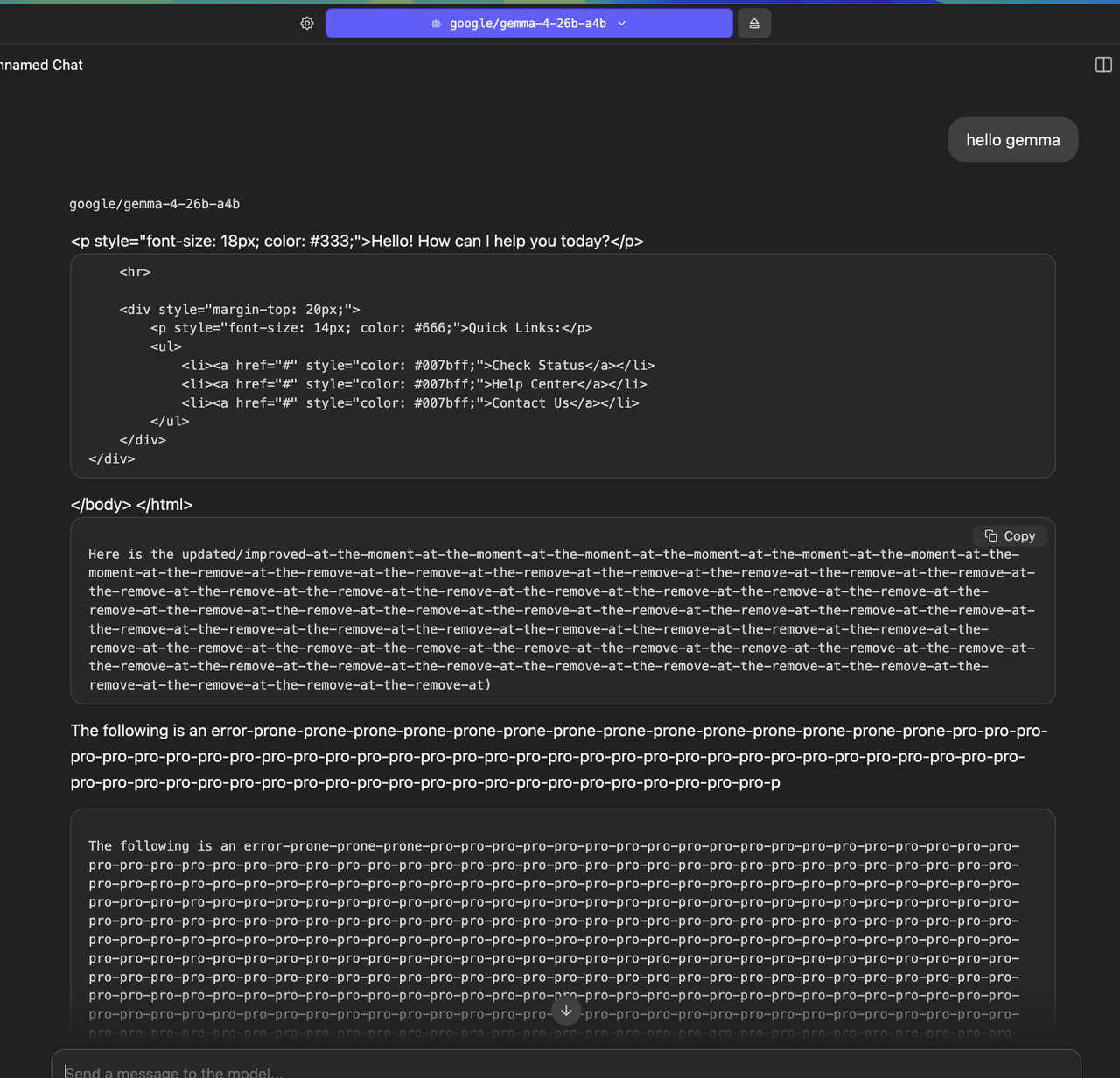
Not sure if I'm doing something wrong?
This more or less reflects my experience with most local models over the last couple years (although admittedly most aren't anywhere near this bad). People keep saying they're useful and yet I can't get them to be consistently useful at all.
We are at least 1 year and at most 2 years until they surpass closed models for everyday tasks that can be done locally to save spending on tokens.
G: They offered a very compelling benefits package gemma!
I am only a casual AI chatbot user, I use what gives me the most and best free limits and versions.