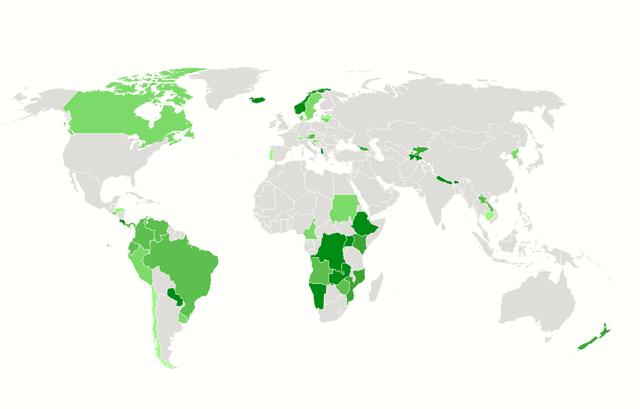
Seven countries now generate 100% of their electricity from renewable energy
380 points - today at 1:21 PM
SourceComments
Let's head to electricitymaps.com !
Albania (https://app.electricitymaps.com/map/zone/AL/live/fifteen_min...)
- On 2026-04-12 16:45 GMT+2, 22,67% of electricity consumed by Albania is imported from Greece, which generates 22% of its electricity from gas. Interestingly, Albania exports about as much to Montenegro as it imports from Greece.
Bhutan:
- 100% hydro, makes perfect sense
Nepal:
- 98% hydro, a bit of solar for good measure
Iceland:
- 70% hydro, 30% geo
Paraguay:
- 99,9% hydro
Ethiopia:
- 96,4% hydro
DRC
- 99.6% hydro
So, the lessons for all other countries in the world is pretty clear: grow yourselves some mountains, dig yourselves a big river, and dam, baby, dam !!
(I'm kidding, but I'm sure someone has a pie-in-the-sky geoengineering startup about to disrupt topography using either AI, blockchain, or both.)
His past research was already cited by Leonardo DiCaprio on Sept. 23 2014, during opening of the UN Climate Summit.
“The good news is that renewable energy is not only achievable but good economic policy,” DiCaprio told the more than 120 world leaders assembled. “New research shows that by 2050 clean, renewable energy could supply 100 percent of the world’s energy needs using existing technologies, and it would create millions of jobs.”
https://cee.stanford.edu/news/what-do-mark-z-jacobson-leonar...
The 100% renewable papers by Mark Z. Jacobson were subject to strong criticism. Jacobson filed a lawsuit in 2017 against the Proceedings of the National Academy of Sciences and Christopher Clack as the principal author of the paper for defamation. In February 2024, Jacobson lost the appeal and was required to pay defendants more than $500,000 in legal fees.
https://en.wikipedia.org/wiki/Mark_Z._Jacobson
Jacobson is also very strong critic of nuclear energy. In calculating CO2 emissions from using nuclear energy, he includes carbon emissions associated with the burning of cities resulting from a nuclear war aided by the expansion of nuclear energy and weapons to countries previously without them.
Jacobson assumes that some form of nuclear induced burning that will occur once every 30 years.
- California: 83% renewable, dominated by solar
- Spain: 73%, dominated by solar & wind
- Portugal: 90%, dominated by wind & solar
- The Netherlands: 86%, dominated by solar & wind
- Great Britain: 71%, dominated by wind & solar
There's real momentum happening.
Not to downplay the positive steps that are being taken towards using renewable energy worldwide, but one must point out that all those countries except one are almost exclusively using hydroelectric power, whose availability at such scale is a geographical lottery. As for Iceland, which also relies mostly on hydroelectric power but not in such great a proportion, it makes up for it thanks to easy and abundantly available geothermal power (which, though environmentally friendly, is arguably not technically renewable).
Just because a country generates 100% of its energy from renewables, it doesn't mean that its enough to power the entire or even majority of the country. Case in point: DRC. I believe only half of the population has access to electricity. It's been a while since I've looked into continental stats, but a quick Google search suggests the situation hasn't changed that much in the last few years.
One state is considered to be fully 'renewable' if the means of transport (excluding Airplanes since I can't find a suitable alternative ) for land is done via electric cars
https://www.nytimes.com/2026/03/23/climate/offshore-wind-gas...
This map says hydro share is like 8%. https://app.electricitymaps.com/map/zone/JP/live/fifteen_min...
[1]: https://web.stanford.edu/group/efmh/jacobson/WWSBook/Countri...
The best way to go green is still going green yourself. Get some panels, batery, inverter and go where no government wants you to go, off-grid. (And a gas generator, too, just in case...)
Why is it that those are reserved for ultra-big utility companies and I cannot buy those for my home or even my balcony?
The only countries with <100 g CO2/kWh and >10TWh/y are using nuclear. Large scale batteries are exciting for the future but need more development. The 2 biggest battery investments in the world are being made in Australia and California, yet still produce 4x the g CO2/kWh of France.