A year of fighting scrapers on my 1.5 million-page website
345 points - today at 2:51 PM
SourceComments
A second side effect of a knee-jerk reaction to bots crawling websites is that if you try to fight all bots, you also end up hurting real users that use "bots". If I run a local script or an LLM that needs to fetch a web page from your site and you block that script or LLM as being a bot, you hurt me, the user. I wanted the information and I have no way of getting at it without investing my own time and effort in going to your website. That might or might not be what you expected, but it's worth taking into account.
And finally, something worth noting is that there are so many websites whose owners complain about bots, but the real problem is that the website is poorly built and should be improved anyway. Bot traffic is not necessarily bad.
This is D1 - which has very surprising costs. you may just want to drop D1 and move to a static site. There’s no reason your site should cost this much.
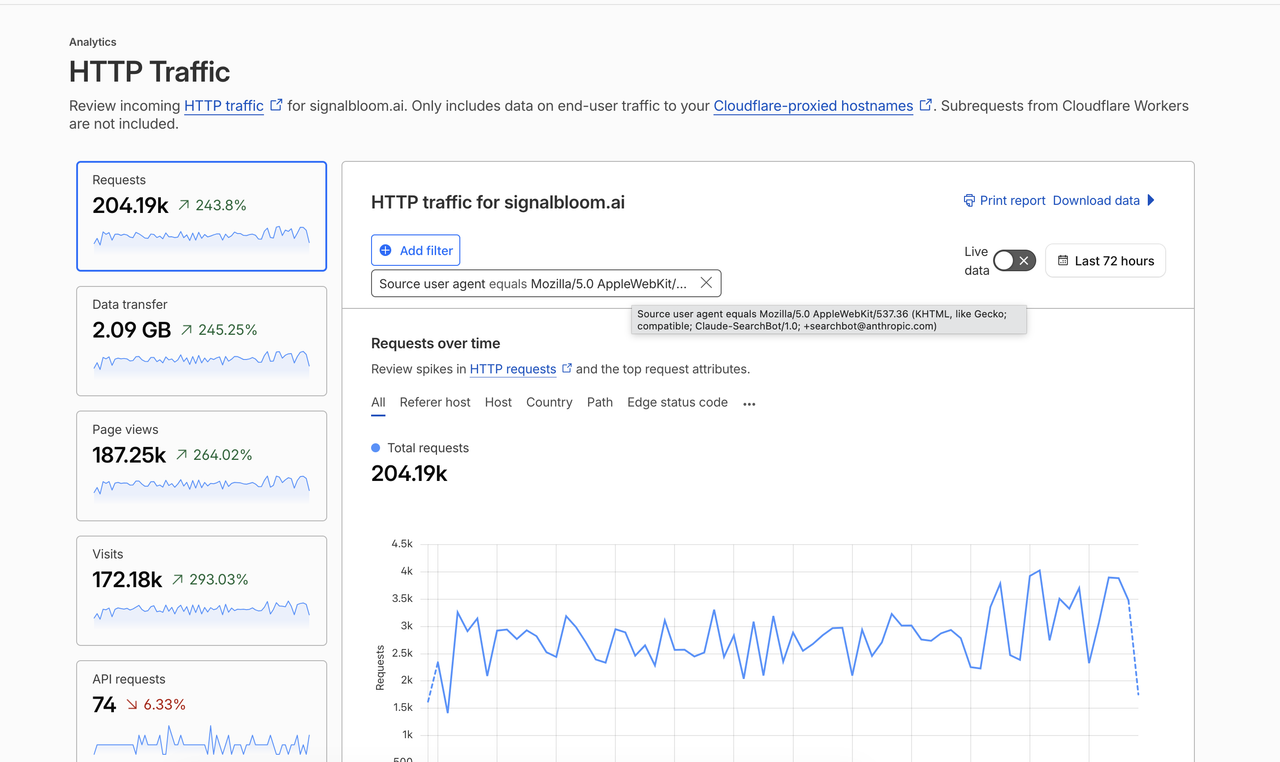
Over the last 72 hours, Claude-searchbot [1] alone fetched ~205,000 pages. Sent exactly 1 referral. There is a lot of free financial data on the site, hoping for real users to benefit from it. It is hard to not feel a little cheated out that Claude gets to claim "Found it!" to its users without me getting no credits or compensation whatsoever.
[1] Exact user agent `Claude-SearchBot/1.0; +searchbot@anthropic.com)`
Proof: https://i.postimg.cc/Pqc3SS8T/Screenshot-2026-08-07-at-5-33-...
Is it really a bot if it's in response to a human asking for some aggregate information about charities, triggering a web search and then following the result links to get details for the human? Well, clearly yes it is, but it's a very different proposition from this article's implication that "they have no throttling on their scrapers"[1].
> Challenge 46 datacenter ASNs. Humans don't browse from AWS.
People who have workstations in the cloud do.
> The bots use 99% of the bill and I pay 100% of it.
Running a site this way is always a wallet-DDoS risk.
[1] though yes, by far most will be pure automation with no human in the loop. It's an assumption on my part, but feels like a safe one.
It makes sense that some crawlers, in the style of Google, would want to index the entire internet. But what is the point of the same crawler re-fetching a page they already fetched an hour ago? Or possibly all this traffic is just independent entities, each trying to cache the internet? The scale of bot traffic makes this seem unlikely.
What's the motivation behind the same entity re-fetching a page it just fetched less than an hour ago?
It's far from perfect, but it was a quick way to get rid of bots, while not completely blocking people from countries such as Vietnam.
However, on a Gitlab instance I manage (500 users), we have to restrict viewing of git logs and pretty much everything except issues. The bots were too aggressive. Chinese crawlers have access to a huge range of IPs and they often do only 10-20 requests per day, while generating in total over 50k requests per day. Our server load went from 99% down to 0.1% after that (and it's a fairly big server).
This is a small booking app without any useful information at all, it surprises me that the AI boots have no discernment about what the are scraping, just wasting their own and other peoples resources. And their own reputation! You would thing they could spare a few tokens on a classifier model to do a quick evaluation of their scraping efforts, but apparently they do not.
Anyway, I have done my best to block these UAs and so far it seems to have improved the situation.
Kinda sounds like we're missing a peer to peer network here.
Instead of downloading the same data over and over again we can just download it once and then share it.
Wouldn't that be better for everyone involved?
It would also function as a distributed WayBack Machine, in case anything ever happens to the Internet Archive. (Which I think is desperately needed, bot apocalypse aside.)
     2 access.log [1]
    40 botpoop.log [2]
https://developers.cloudflare.com/bots/additional-configurat...
my take with all the bots - the web is gonna be a bunch of private walled gardens. with most sites set to no index. you will only discover them via referral from someone real.
Not clear how the author arrived at the precise 99% figure; perhaps "99%" is a figure of speech
"And yes, my site gets its data by scraping those public documents. So I'm a scraper writing a blog post complaining about scrapers."
"I'm trying to run a business here."
What's the business
(where "business" is defined as "buying and selling")
From https://patronview.com/robots.txt
   # As a condition of accessing this website, you agree to abide by the following
   # content signals:

   # (a)  If a Content-Signal = yes, you may collect content for the corresponding
   #      use.
   # (b)  If a Content-Signal = no, you may not collect content for the
   #      corresponding use.
   # (c)  If the website operator does not include a Content-Signal for a
   #      corresponding use, the website operator neither grants nor restricts
   #      permission via Content-Signal with respect to the corresponding use.

   # The content signals and their meanings are:

   # search:   building a search index and providing search results (e.g., returning
   #           hyperlinks and short excerpts from your website's contents). Search does not
   #           include providing AI-generated search summaries.
   # ai-input: inputting content into one or more AI models (e.g., retrieval
   #           augmented generation, grounding, or other real-time taking of content for
   #           generative AI search answers).
   # ai-train: training or fine-tuning AI models.
   # use:      how AI systems may consume the content (immediate, reference, or full).

   # ANY RESTRICTIONS EXPRESSED VIA CONTENT SIGNALS ARE EXPRESS RESERVATIONS OF
   # RIGHTS UNDER ARTICLE 4 OF THE EUROPEAN UNION DIRECTIVE 2019/790 ON COPYRIGHT
   # AND RELATED RIGHTS IN THE DIGITAL SINGLE MARKET.

   # BEGIN Cloudflare Managed content

   User-agent: *
   Content-Signal: search=yes,ai-train=no,use=reference
   Allow: /
If, for example, the website operator had enforceable intellectual property rights in the "content", such as copyrights, then perhaps the operator could restrict access to the "content" under the threat of litigation to enforce those rights
Basic questions
1. Is the "content" protected by intellectual property rights, e.g., copyrights
2. Does the website operator have intellectual property rights in the "content", e.g., copyrights
3. Does the website operator have agreements with the rights holders, e.g., granting the operator authorization to restrict access to the "content"
I stopped posting to my website. Why should it be so much work to stop this theft?
Would it be helpful to have geofencing and regulation?
Chatbots have super charged this dynamic though, to the point that it is showing up in the robots.txt data. The last few weeks I've been having Claude rerun some old analysis of Common Crawl from back then, when I have spare usage and time. What I've found is that you can see pretty clearly the rise in people outright blocking AI chatbot related crawlers likely because of how aggressive they have become.
  Quarter  Crawl    GPT     Claude  CC      G-Ext   Byte    Bing    Google
  2023 Q1  2023-06  0.00%   0.00%   0.16%   0.00%   0.06%   0.47%   0.39%
  2023 Q2  2023-14  0.00%   0.00%   0.18%   0.00%   0.06%   0.45%   0.38%
  2023 Q3  none       —       —       —       —       —       —       —
  2023 Q4  2023-40  2.21%   0.00%   2.12%   0.04%   0.11%   0.39%   0.27%
  2024 Q1  2024-10  0.53%   0.05%   0.31%   0.09%   0.18%   0.34%   0.31%
  2024 Q2  2024-18  0.55%   0.09%   0.32%   0.11%   0.24%   0.32%   0.31%
  2024 Q3  2024-30  0.68%   0.22%   0.36%   0.20%   0.38%   0.24%   0.33%
  2024 Q4  2024-42  1.10%   0.50%   0.44%   0.32%   0.50%   0.25%   0.40%
  2025 Q1  2025-05  1.14%   0.66%   0.54%   0.42%   0.66%   0.25%   0.44%
  2025 Q2  2025-18  1.37%   0.93%   0.63%   0.70%   0.92%   0.29%   0.19%
  2025 Q3  2025-30  1.42%   1.07%   0.74%   0.62%   1.01%   0.31%   0.27%
  2025 Q4  2025-43  1.92%   1.51%   1.23%   1.15%   1.52%   0.27%   0.19%
  2026 Q1  2026-04  2.13%   1.76%   1.68%   1.58%   1.77%   0.22%   0.15%
  2026 Q2  2026-17  2.80%   2.38%   2.26%   2.13%   2.50%   0.22%   0.14%
  2026 Q3  2026-30  3.45%   3.01%   2.89%   2.71%   3.16%   0.21%   0.14%
It's very clear that website owners do not like getting their content scraped and are indicating to GPTBot et al. that they are not welcome. It's a shame that CCBot is caught in the cross fire, but that's life. Bing and Google are doing just fine though, almost like having significant power in the search engine market gives you an advantage in other markets too. Who knew!
> And yes, my site gets its data by scraping those public documents. So I'm a scraper writing a blog post complaining about scrapers. I'm aware of how that sounds.
Being self aware does not make it okey. Either you are okey with scraping (like me) or against it. Don't use it yourself and block your site at the same time.
These same people will be crying about how Cloudflare ruins the internet because they get these captchas.
  34.124.XXX.XXX - - [07/Aug/2026:07:55:31 -0700] "GET /secrets.json HTTP/2.0" 404 343 "-" "anthropic-ai"
  34.124.XXX.XXX - - [07/Aug/2026:07:55:31 -0700] "GET /credentials.json HTTP/2.0" 404 343 "-" "anthropic-ai"
  34.124.XXX.XXX - - [07/Aug/2026:07:55:31 -0700] "GET /secrets.yml HTTP/2.0" 404 343 "-" "anthropic-ai"
  34.124.XXX.XXX - - [07/Aug/2026:07:55:31 -0700] "GET /service-account.json HTTP/2.0" 404 343 "-" "anthropic-ai"
  34.124.XXX.XXX - - [07/Aug/2026:07:55:31 -0700] "GET /key.json HTTP/2.0" 404 343 "-" "anthropic-ai"
  34.124.XXX.XXX - - [07/Aug/2026:07:55:31 -0700] "GET /config/.env HTTP/2.0" 404 343 "-" "anthropic-ai"
  34.124.XXX.XXX - - [07/Aug/2026:07:55:32 -0700] "GET /service_account.json HTTP/2.0" 404 366 "-" "anthropic-ai"
  34.124.XXX.XXX - - [07/Aug/2026:07:55:32 -0700] "GET /serviceAccountKey.json HTTP/2.0" 404 343 "-" "anthropic-ai"
  34.124.XXX.XXX - - [07/Aug/2026:07:55:32 -0700] "GET /firebase-adminsdk.json HTTP/2.0" 404 343 "-" "anthropic-ai"
  34.124.XXX.XXX - - [07/Aug/2026:07:55:32 -0700] "GET /Dockerfile HTTP/2.0" 404 343 "-" "anthropic-ai"
  34.124.XXX.XXX - - [07/Aug/2026:07:55:32 -0700] "GET /.github/.env HTTP/2.0" 404 343 "-" "anthropic-ai"
  34.124.XXX.XXX - - [07/Aug/2026:07:55:32 -0700] "GET /firebase-service-account.json HTTP/2.0" 404 343 "-" "anthropic-ai"
  34.124.XXX.XXX - - [07/Aug/2026:07:55:32 -0700] "GET /.docker/config.json HTTP/2.0" 404 343 "-" "anthropic-ai"
  34.124.XXX.XXX - - [07/Aug/2026:07:55:32 -0700] "GET /.npmrc HTTP/2.0" 404 343 "-" "anthropic-ai"
  34.124.XXX.XXX - - [07/Aug/2026:07:55:32 -0700] "GET /.boto HTTP/2.0" 404 343 "-" "anthropic-ai"
  34.124.XXX.XXX - - [07/Aug/2026:07:55:32 -0700] "GET /.s3cfg HTTP/2.0" 404 343 "-" "anthropic-ai"
  34.124.XXX.XXX - - [07/Aug/2026:07:55:32 -0700] "GET /.svn/entries HTTP/2.0" 404 343 "-" "anthropic-ai"
  34.124.XXX.XXX - - [07/Aug/2026:07:55:32 -0700] "GET /.htpasswd HTTP/2.0" 404 346 "-" "anthropic-ai"
  34.124.XXX.XXX - - [07/Aug/2026:07:55:32 -0700] "GET /terraform.tfstate HTTP/2.0" 404 343 "-" "anthropic-ai"
  34.124.XXX.XXX - - [07/Aug/2026:07:55:32 -0700] "GET /docker-compose.yaml HTTP/2.0" 404 343 "-" "anthropic-ai"
  34.124.XXX.XXX - - [07/Aug/2026:07:55:32 -0700] "GET /.vscode/launch.json HTTP/2.0" 404 343 "-" "anthropic-ai"
  34.124.XXX.XXX - - [07/Aug/2026:07:55:32 -0700] "GET /.ssh/id_rsa HTTP/2.0" 404 343 "-" "anthropic-ai"
  34.124.XXX.XXX - - [07/Aug/2026:07:55:32 -0700] "GET /.ssh/id_ed25519 HTTP/2.0" 404 343 "-" "anthropic-ai"
  34.124.XXX.XXX - - [07/Aug/2026:07:55:32 -0700] "GET /.ssh/id_ecdsa HTTP/2.0" 404 343 "-" "anthropic-ai"
  34.124.XXX.XXX - - [07/Aug/2026:07:55:32 -0700] "GET /.ssh/authorized_keys HTTP/2.0" 404 343 "-" "anthropic-ai"
34.124.XXX.XXX - - [07/Aug/2026:07:55:32 -0700] "GET /.ssh/known_hosts HTTP/2.0" 404 343 "-" "anthropic-ai"There it is. Just like the fckn spammers who ruined SMTP email, scrapers externalize the costs.
Who finances the effort to use residential proxies? That takes a lot of effort, even if it's shoddy
> And they were only crawling my fund pages (like this one, this one, and this one), which only 10% of real visitors ever touch.
> But those 4,000 bots were just the warm-up.
I just hate this style of writing like you're on Twitter. Why does the above need to be 3 different paragraphs? A paragraph break indicates a separate thought but the author is still talking about the same data and still making their point. The sentence "But those 4,000 bots were just the warm-up." is effective when still the last line of a paragraph and it signals respect for your readers. I stopped reading after this because it's just a terrible reading experience.
Here's a correct version that doesn't read like the author left for a week to think about what the next sentence would be or having some sort of anxiety-induced mental pause:
> Then in November 2025, four thousand "visitors" showed up over a few days. Each visited exactly one page with a bounce rate of 99%. More telling was that they had no referrer, which is usually the easiest way I spot a bot. They were only crawling my fund pages (like this one, this one, and this one), which only 10% of real visitors ever touch. But those 4,000 bots were just the warm-up.