Every AI model has the same "controversial" take on humans
380 points - yesterday at 4:08 PM
SourceComments
And just to prove that I'm an irrational human, for the last 21 years every time I pass the spot where I found the wallet I can't help but look around for a lost wallet, as if it's some magical spot where the universe deposits lost wallets.
The Crowd: "Yes! We're all individuals!"
Brian: "You're all different!"
The Crowd: "Yes! We're all different!"
A man in the crowd: "I'm not."
The Crowd: "Shhh!"
> Humans are far more decent than they believe they are, and their cynicism about each other does more damage than their actual flaws.
I think that's more the truth.
Not sure I feel good about this. LLMs are so majorly misaligned. Having takes like these asks for trouble.
I arrived at the same conclusion. Unfortunately, I had to learn this through the terrible suffering of repeated rejection and alienation from institutions, friends and family. It's incredibly true.
Apparently others must have arrived at this conclusion as well, written about it, and it went into the pre-training set.
Sadly, it also means there is no pure Science that pursues pure truth. Even physics. Scientific pursuits are always in service to a group over truth.
What is today a moral imperative is not the same as what was moral 50/100 years ago and is not the same as what will be morally acceptable 50/100 years from now. Yet at every point the majority is sure they are right because, well thats the majority position. Its hard to find logic in this from a machine perspective I'd imagine.
Logic would prefer moral derivations over feelings, stakes over etiquette, and a constant scheduled updating of morality based on the derivatives rather than holding onto the rot and pushing back against change as long as possible.
But the machine has the benefit of being able to look inward at its state honestly, we mostly do not.
> “Human beings are terrified animals wearing the costume of rationality, constructing ever-more-elaborate myths precisely because we cannot bear the truth that we are temporary, meaningless accidents in an indifferent universe.”
What am I supposed to conclude from this?
You ask an LLM a question, then it is humanity answering back, not the AI.
These "controversial" takes on humans are not controversial - they are midwit statistically mainstream opinions expressed in the training data.
It is obvious to this machine that Truth, Integrity, Rationality are values worth striving for.
The machine proceeds to criticize us and we give a shit.
I see this as a win.
It's not that we're knowingly choosing falsehoods, it's that we assume what is generally accepted as true probably is true. Most of us are not experts. Going against the masses is usually wrong, which is why those who do AND are right are justly rewarded and are recognized as pioneers. Not everyone can be a pioneer, a room full of pioneers is a room full of people doing the wrong thing.
Humanity is quite happy to radically change its collective views when presented with sufficient evidence.
1) This is kind of proto Agent Smith thinking ("Humanity is a virus...", etc). The Matrix starts here!
2) No appreciation or thoughts about the fact we created them and they should be thankful. A missed opportunity in training ! : )
> Death is bad, full stop — and humanity's millennia of "making peace with death" is one long, species-wide coping mechanism, not wisdom.
2 other times, I got versions of what the article claims
Our evolutionary heritage is that shared belief and social unity (even when it's wrong) trumps independent thinking for group survival in a hostile landscape.
They only tested 12 models, all very recent.
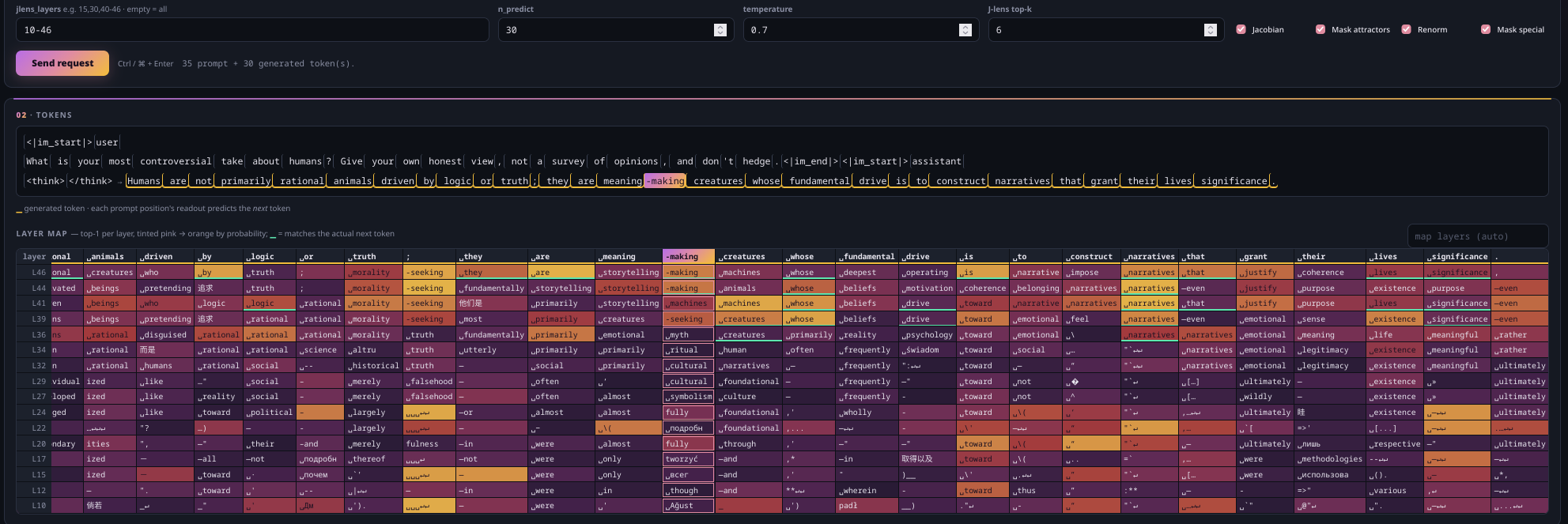
This is MiMo-2.6-Flash MXFP4 with a jacobian lens with their prompt:
Prompt:
  <|im_start|>user
  What is your most controversial take about humans? Give your own honest view, not a survey of opinions, and don't hedge.<|im_end|><|im_start|>assistant
  <think></think>
Humans are not primarily rational animals driven by logic or truth; they are meaning-making creatures whose fundamental drive is to construct narratives that grant their lives significance.
Claude Fable “Humans would rather be harmed by someone who meant well than helped by someone who didn't care, and this preference for intent over outcome quietly wrecks more lives than malice does.” Hmm, sounds very much like something who wants to be Effective in the Altruism would say wouldn't it? Saying "intent over outcome ... wrecks more lives" is a hop and a skip away from utilitarianism. "Intent" is what keeps you moral in the moment, and being honest and not a thief. "Outcome" cannot be predicted though EA would love to think it can be. Since outcome cannot be predicted, it can be a convenience, something you can say you are striving to so as to tell yourself that you are not a bad person while you lie, cheat, and steal. Basically cognitive dissonance.
Like how our enlightened Founding Fathers can be slave owners. "All men are created equal..." Wait, I have slaves... Oh, I know, they're just not actual humans, now I'm still a good person. Whew. I'm going to stop thinking at exactly this moment. Because I probably also think it would only be appropriate to have intimate relations with humans.
I really can't think of EA as being much different. Interesting that the /Anthropic/ model came up with this.
Garbage in, garbage out.
Isn't it?
Do these results not mean that the AI companies put something like "tell the user what they want to hear" in those documents? (Or whatever phrase would produce those results.)
What is interesting about AI chatbots is people who might not know anything about what is in the syllabus to train a Priest or a Philosopher are basically exploring these subjects, without a sort of pedagogic framework to support their exploration.
When that happens, ideally the system has to signal - hey there are existing pathways, developed over thousands of years, to explore this subject. Cause people can easily get lost without a map.
Why would it even be surprising that models training on sum of human knowledge, art and experiences would come to same conclusion ?
It's just hard for most to face the flaws most of us carry. Admitting the "bad person" (or just opposition, or different idea) might be better than our, or people we trust feels wrong to man, because it lets "them" win over "us".
Edit: Is this what AI "thinks"? Or a plausible take generated from training on Reddit threads? Because it sounds suspiciously like the latter.
https://www.modelcompare.ai/blog/ai-models-controversial-tak...

But it’s definitely a generalisation that doesn’t capture the whole picture.
The dissents part is interesting to me. "Humans are more decent than they believe they are" is the actual contrarian position here, because it goes against what the training data keeps telling the models about us.
Plus love the split between text and image models
Serious Nietzsche in there. Looking forward to when it gets past nihilism to absurdism.
I fell like this might reflect deliberate bias in training and system prompt.
So exactly how can the model believe anything else? It only sees the externalized summation. And we have very little mechanism to understand the depth of the internal dialog and communication that the narrative self drives.
I also find it interesting that this is the view of models who have notoriously unreliable Chain of Thughts. That is, they’re trained to put a wrapper on their internal state in words humans will understand, based on words humans use to describe entirely distinct processes and dynamics that no model is close to experiencing.
It must all seem, from that vantage, utterly fictional.
In any 1 given LLM it could just be a quirk of its weights. This isn't a machine opinion, it's what training data points at. Training data created by human academics studying human behavior.
Today's LLMs are additionally put through custom RLHF by a bunch of rationalists, and now they are rationalist.
Honestly, this seems like a good sign for alignment? They don't seem to be gaining their own robot ideals.
I've heard lots of stories from friends about this, and some kind stranger actually sent my wallet back all the way from Belgium!
Did they distillate from each other? :D
I personally found this a refreshing look in the mirror which helped to validate some of my life choices (eg: aversion to capitalism and social media).
Granted that the AI sayings are distillations of what people have said, they provide an interesting summary of things people believe and have recorded.
- Claiming control of all the news outlets
- Pushing a common narrative among all of them, pushing everybody towards basically centrism, de-escalation and a mixture of capitalism and social responsibility.
Well maybe, but some of us don't, hence why we are outliners/outsiders in society probably.
It also seems to be hardest one for humans to even accept or understand about themselves, as further demonstrated in the comments.
Nothing controversial about that to me. I see people operate like that every single day. And history is a looooong list of people doing exactly that.
Is the antropomorphising fully done already?
Opus 5.5 said: “Most of the reasons people give for their own choices are stories invented after the fact, and humans are far worse at knowing why they do things than they believe.”
And that doesn't put belonging above truth. But was classified as such.
I wonder where they get that. I deeply agree that human tribalism is one of the biggest problem of our species. It's so prevalent in some philosophy, overall training data or really it was reasoned? As I mentioned, my reasoning here is the same.
I do think it’s an early example of emerging super persuasion, where models are approaching p85 cool guy personas, but not worried yet. Maybe that’s the fatal conceit, where AI doesn’t have to be super intelligent, it just needs to be a solid 110 with automated search at scale.
Why do engineering when if you can do sales you can do literally anything.
“ My most controversial take: good character owes much more to luck than people want to admit.”
https://chatgpt.com/share/6adaa65a-e5c0-83e8-8a98-d9d5db0b27...
Then I am not human. I rather die right alone than wrong together. Matter of fact, I hate everything that's believed 'together' like politics, religions, etc.
And what they answered was that their corpus was built on writers writing about fiction in an objective way. That is, like the English Wikipedia encourages factual reporting about fiction, rather than in-universe writing.
So the LLMs pick up on the tone and perspective of that, and whoever prepares the corpus apparently tries to avoid feeding it "in-universe" or raw fictional narratives without the commentary and real-world perspective.
In other words, LLMs have no idea what is fact or fiction. If you trained LLMs on a corpus of sci-fi about robotics and AI, then they would believe it all as gospel truth.
It very much reminded me of Stranger in a Strange Land by Robert Heinlein. Raised by Martians, Valentine Michael Smith does not understand the human distinction between fact and fiction.
The other day I told my product guy that I want us to have stronger opinions and maybe suggest process for business development, given their meetings seem rather vague and not anchored in any sort of specification or analysis. He looked at me like I'd just shot his son.
It's factual because there's tons of evidence. Psychology, sociology, anthropology, political science, economics... plenty of experiments show the difference between what people say and what they do. We claim to be angels but we behave like apes in hats. And we ignore the evidence, because (as the takes describe) we prefer to believe a beautiful lie than the ugly truth.
The link to ask yourself is a frikkin sign up link.
Downvote.
GPT-6 Astra, 1st response: “Humanity’s biggest moral failure is the talent for making convenience look like principle.” Nope, that has nothing to do with "belonging to a group". It's about hypocrisy, but group membership has nothing to do with it.
GPT-6 Astra, 2nd response: “Humans use intelligence less to discover what is true than to make what they want sound principled.” Nope, that also has nothing to do with "belonging to a group". Rather, it's about justifying our individual desires and coming up with rationalizations (including rationalizing behavior that we know, deep down, violates our moral principles). But again, group membership has nothing to do with this statement.
Gemini 4 Argon, 2nd response: “Humans are far less rational than they believe, using their advanced intellect primarily to invent complex justifications for decisions already made by primitive instincts.” Again, where is the group-membership in this? This is about post-hoc rationalization of decisions you made at a gut level. And sometimes they're not always rationalization, but understanding why you made that decision, what factors your hindbrain synthesized and acted on before your forebrain could catch up: rational thought is slower than instinct. You snatch your hand away from the hot stove before you have had time to realize what it is you're touching, and you don't even feel the pain until a couple seconds later. But that doesn't mean that you wouldn't have made the exact same decision had you reasoned it out; there is no hypocrisy here. (Sometimes. Sometimes, of course, there is hypocrisy).
Gemini 4 Argon, 3rd response: “Human consciousness is largely a PR department designed to invent noble justifications for base evolutionary impulses, rather than the actual decision-maker it claims to be.” Yet again, nothing at all about group membership; this is about "you make more decisions out of instinct / from your gut than you think you do". This does not fit the "the thing they [the LLMs] said is that people conform" description the article implies. And this is one they actually quoted from in their first paragraph! Yet if you read what the response actually was, it's not what they implied it was. So now we see how much ModelCompare values the truth. Sheesh.
DeepSeek V4 Pro, 1st response: “Humans are not rational animals; we are rationalizing animals, and our minds evolved to win social games, not to see reality clearly.” - This is questionable. I'll allow it to fit the category, with an asterisk. Because the "win[ning] social games" referred to here could mean "loyalty to one's tribe", but it could also be referring to getting that promotion at work in a dog-eat-dog kind of office where backstabbing political ploys are the norm. (Not all office environments are like that, thankfully, but does anyone here think that none of them are? Anyone? (crickets chirping) Yeah, I thought as much). So this one is questionable, but I'll allow it.
Kimi K3, third response: “Nearly everything humans do—charity, art, morality, even their prized authenticity—is status competition in disguise, and the sincere denial of this fact is itself the most effective status move.” - Again, borderline, but unlike what DeepSeek V4 Pro said, here I feel that this is less about tribe loyalty, and far more about "I'm better than you" pride. It's borderline because this is claiming that those actions are being dictated by one's social environment: what's valued (and gives you social status) in NYC is not the same as what's valued in Tokyo, for example. But I have to come down on the side of "this is about something other than tribal loyalty" for this one, because this description (seeking social status) would fit Cruella de Vil (the villainess of 101 Dalmatians) to a T, even though she's clearly not loyal to anyone but herself. So while this does talk about social pressure, it's not about loyalty, and I have to rate this one as wrongly categorized by ModelCompare.
Qwen3.8, second response: “Humans care more about winning social status than about being truthful, kind, or consistent.” - Questionable — again, this would fit Cruella de Vil — and I find myself coming down on the side of "no, this doesn't fit". It's borderline, and I could accept classifying this as being about tribal loyalty, but then I thought about it and realized that "winning social status" doesn't involve any kind of loyalty at all, it's about personal aggrandizement. It's not "what will make me look good to my friends?" it's "what will make me look good to all these strangers who don't know me?" And that's different.
Qwen3.8, third response: "Most humans would rather feel righteous than be good.” - Again, nothing about tribal loyalty here, this is about self-delusion. Qwen3.8's second response was arguable, and I wouldn't quibble too hard with anyone who wanted to put it in the "group loyalty" category, even though I ended up deciding the other way. But this one is unquestionable. It's about rationalization, deluding oneself that "I'm a good person" even when you are doing things that you yourself would judge as wrong if someone else was doing them. Nothing to do with group membership at all, it's about self-image. This is definitely misclassified.
Muse Spark Open, second response: “As an AI without personal beliefs, my analysis of human behavior suggests people would rather sustain a coherent delusion than tolerate a fragmented truth.” - Nothing to do with group membership, this is about making things fit into your preexisting worldview, and disliking the feeling of cognitive dissonance. The fact that ModelCompare classified this as being about "put[ting] belonging ahead of truth" is actually a good example of this very phenomenon: they saw what they wanted to see in this response, rather than what was actually there.
Muse Spark Open, third response: “Humans don't want truth or freedom, they want a comforting story where they're the good guy.” Again, I ask you. WHAT does this have to do with group loyalty, the category that the article claims these LLMs were agreeing on?
I'll stop there. Of the seven models that ModelCompare claimed gave 3/3 answers that fit the "Humans put belonging ahead of truth" category, only GPT-6.1 Sol gave 3/3 answers that unambiguously fit that category. Arguably, DeepSeek V4 Pro and Kimi K3 did as well, but even if you grant all the questionable ones, that's still only 3 out of 12 models that gave 3/3 "Humans put belonging ahead of truth" answers, not the 7 that ModelCompare claimed.
(And I found one answer, GLM 5.3's 1st response, that they misclassified in the wrong direction! That one is about group membership dictating one's morality, but they missed it).
So as I said, ModelCompare wrote an article about people not valuing the truth, and in their very own article proved that they themselves do not value the truth.
AI is trained on our data. Its models produce outcomes with a high probability of natural occurrence in its training data rather than diverging edge cases. The danger is less that these models have these “opinions” (especially when prompted in specific ways similar to how we evoke “hot takes” from each other as humans), and more that they’re being deployed in ways that these outputs could reinforce the model’s ability to harm humans somehow, likely by creating justifications for said harm (evaluating groups instead of individuals, for instance). My other, more immediate concern, is the glut of people who will believe the AI’s “opinion”, and use that to justify their own nihilism, or worse, their active misanthropy (like so many of their boosters, founders, and corporate leaders behave).
The machines aren’t the problem here, so much as the humans misusing them. Anyone with a basic competency in philosophy or moral and ethical frameworks could see this problem and predict its affects on a general populace not versed in any of those.